Triton Submersible
Deception PointThe Triton is a one-person submersible aboard the Goya, introduced as a glass-domed vehicle that seems to put its occupant in direct contact with the ocean. During the attack on the ship, its size and slow launch make it an impossible refuge for the group; later, Michael Tolland uses its manipulator claws and pressure-resistant dome to turn it against the armed men. Its changing role—from frightening exposure to effective protection—makes the Triton a decisive tool in the fight aboard the Goya.
Design and First Impression
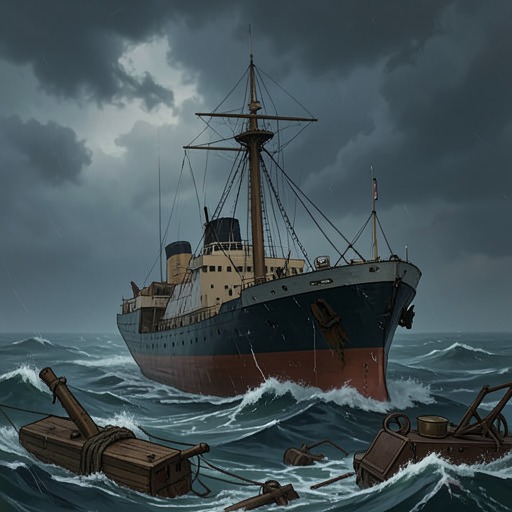
The Triton hangs from a giant winch at the stern of the Goya. Its forward hemispherical acrylic dome distinguishes it from the older, steel-encased Alvin: instead of presenting an opaque metal shell, it resembles a giant fishbowl, with a clear barrier between its occupant and the sea. Rachel Sexton finds the prospect of descending hundreds of feet behind that sheet of acrylic especially unnerving. Tolland explains that the unpleasant part of riding in the Triton is its deployment: it is lowered slowly through a trap door in the Goya’s deck, swinging like a pendulum about thirty feet above the water.
That initial impression makes the vehicle’s transparency seem like exposure, but the later attack reveals the misleading nature of that appearance. The dome gives people on deck a reflective view of the ship, while its thick shell can withstand bullets. The Triton’s design therefore serves both as a working feature and as a visual reversal: what looks like a fragile window becomes a barrier the attackers cannot penetrate.
Limits as a Refuge
When gunfire drives Tolland, Rachel, and Corky Marlinson to seek cover, Tolland briefly considers whether the Triton could take them underwater. The possibility is immediately defeated by practical limits. The sub has room for one person, whereas there are three of them; lowering it through the deck and into the sea takes about ten minutes; and without properly charged batteries and compressors, it would be useless in the water. It cannot offer an improvised escape from an attack unfolding in seconds.
Instead, Tolland leads Rachel and Corky down an aluminum ramp belowdecks as the helicopter returns and fires overhead. The contrast establishes that the Triton is not a ready-made solution to every danger: its safety depends on preparation, functioning systems, and time that the group does not have. Its later importance comes not from an easy escape but from Tolland’s ability to use the vehicle under pressure.
The Submersible as a Weapon
Aboard the Goya, Tolland uses equipment at hand to confront Delta-Three. He thrusts an aluminum pole toward the attacker’s feet, using a five-foot Powerhead Shark-Control Device—a self-defense bang-stick fitted with a pressure-sensitive, twelve-gauge shotgun shell. The shot destroys Delta-Three’s right foot and sends his machine gun overboard. Tolland then holds the weapon’s jagged point at the wounded man’s throat. Although this improvised defense is not itself the Triton, it helps secure the deck and sets up the submersible’s next role in the confrontation.
After Delta-Three has been bound and left in front of the sub, Delta-Two approaches cautiously. The Triton’s rounded cockpit dome reflects the deck, giving him the rare advantage of seeing behind himself. But the apparent advantage becomes part of the trap. One of the sub’s manipulator claws suddenly lunges out and clamps onto his left thigh, crushing it and breaking a bone. From inside the Triton, Tolland is at the controls. A second robotic arm then seizes Delta-Two’s right arm, knocking the CrypTalk from his hand and preventing him from calling for help.
The Dome’s Strength and the Triton’s Significance
Delta-Two fires his machine gun directly at Tolland through the acrylic dome, emptying the weapon against the shell. He believes Tolland is dead, but the bullets have not penetrated. Tolland emerges through the sub’s topside portal, visibly shaken but uninjured, and looks over the dome, now marked by bullet craters. He explains its resistance in a brief, pointed remark: “Ten thousand pounds per square inch,” followed by, “Looks like you need a bigger gun.” The exchange turns the enemy’s apparent act of destruction into proof that the Triton has protected its operator.
The vehicle’s use in the confrontation depends on features that initially seemed to make it vulnerable: the transparent dome allows the deck to be seen in reflection, and the manipulator arms extend its reach beyond the cockpit. In Tolland’s hands, those features become tactical advantages. The Triton cannot carry the whole group to safety or be deployed quickly, but it can shield its occupant and restrain an attacker. Its role in the Goya’s defense is thus less that of an escape craft than of a formidable, repurposed instrument: a deep-sea machine brought into a close-quarters fight on deck.